
Artificial Intelligence Research Proposal Writing Services for Scholars & PhD Students
Zero Plagiarism, Zero AI
25% OFFGET INSTANT HELP FROM EXPERTS
Why Choose PWS for Artificial Intelligence Research Proposal Writing?
PWS brings PhD knowledge of AI, ethical research standards, and analytical techniques together in a way that provides novel, approval-ready AI thesis statements.

PhD-Level Authors on Artificial Intelligence and Computer Science:

Experience with Global Universities:

End-to-End Support:

Application of Latest Tools and Datasets in AI:
100% Confidential and Original Work:

Timely Delivery with Revisions:
Testimonials
Develop your research idea for an Artificial Intelligence with guided by leading experts at the PhD-level alongside originality, confidentiality, and academic accuracy.
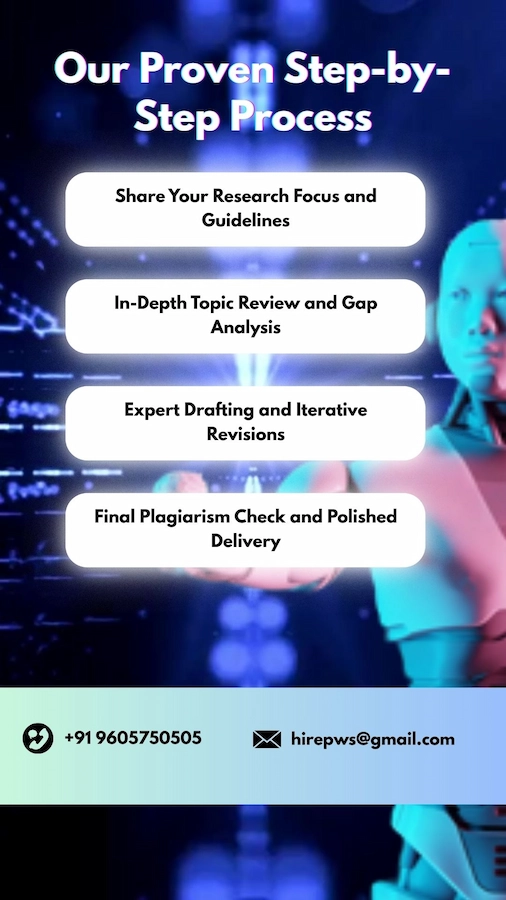
Our Artificial Intelligence Research Proposal Writing Process
Our systematic process is geared at ensuring originality, clarity, and academic conformity throughout the development of your research proposal paper in AI.
Share Research Interests or Guidelines:
You supply the area of interest in research, the guidelines from the university, or example proposal on artificial intelligence in alignment.
Review of Topic and Analysis of Research Gap:
We examine peer-reviewed articles to find the research gap and narrow down a novel, realistic direction for AI research.
Creation of the Draft and Revisions:
The proposal and literature review, methodologies, and algorithms are created by the experts.
Final Proofing and Distribution:
We guarantee that everything from your assignment is 100% plagiarism free and that everything is formatted correctly for final submission.
Why Artificial Intelligence Research Proposal Writing Is Challenging
Rapidly Evolving AI Technologies:
The ever-unfolding breakthroughs in ML, DL, and neural networks make it difficult to keep abreast in academia.
Ambiguities in Objectives and/or Methodology:
Some researchers have difficulty matching their research goals with their experiment design, data gathering, and algorithms.
Crafting Unique Research Problems:
The identification of good research questions in the domain of AI calls for expertise and critical analysis of gaps in existing research.
Organizing a Well-Rounded Literature Review:
The process of identifying reliable and peer-reviewed sources of AI information and keeping a logical flow can be quite complicated.
Strict University Guidelines:
Non-standard proposal formatting, ethics, and methodologies raise the odds of proposal rejection.
What is Included in an AI Research Proposal?
Popular Artificial Intelligence Research Areas We Cover
- Machine Learning & Deep Learning
- Natural Language Processing (NLP)
- Computer Vision & Image Recognition
- Reinforcement Learning

- AI in Healthcare / Finance / Education
- Ethical AI & Explainable AI
- Robotics and Automation
- Data Mining and Big Data Analytics
Our Global Reach in Political Science Research Proposal Writing Help


Curated Research Proposal Topics in Artificial Intelligence for Master’s and PhD Scholars
- AI-Driven Air Quality Monitoring and Control Systems for Smart City Environments
- Machine Learning Approaches for Predicting Drug Safety and Efficacy in Clinical Trials
- NLP-Based Student Modeling Techniques for Intelligent Learning Systems
- Explainable Scene Understanding and Context-Aware Vision Models in AI
- Security and Privacy Challenges in Decentralized Multi-Agent AI Systems
- Algorithmic Game Theory Applications for Intelligent Multi-Agent Environments
- Artificial Intelligence Governance, Regulation, and Policy Frameworks
- Context-Aware Machine Learning Models in Advanced AI Systems
- Frameworks for Aligning Artificial Intelligence with Human Values
- Privacy-Preserving Communication Protocols in Multi-Agent AI Systems
- Hierarchical Planning and Scheduling Models for Intelligent AI Applications
- Knowledge Representation and Reasoning Techniques for AI-Powered Educational Systems
- Design and Evaluation of AI-Integrated Educational Robotics Curricula
- Visualization Techniques for Interpreting Neural Network Decision-Making
- Privacy and Confidentiality Challenges in Artificial Intelligence Applications
Subjects Covered by Our Expert Research Proposal Writers
- Artificial Intelligence
- HRM
FAQs
We assist in Topic selection, Literature Review, Gap Analysis, Methodology, Experimental Design, plagiarism checks, and Confidential delivery.
Yes, our PhD experts find original research topics in AI through the help of gap analysis and trends.
Our solutions are developed by PhD-level experts in AI, ML, data science, and computer science.
Each of these proposal papers has been checked for plagiarism and has been verified for authenticity through Turnitin, and it should include original research ideas.
Timelines range depending on the level of complexity; however, all timelines are completed within stipulated academic timelines.
Yes, amendments are possible as per scope and term and conditions.